Need Help Designing a Simple Circuit to Use as Tube Output for CD Player

SMPS running at typical 250KHz is unlikely to bring much grief into audio, Some bats may be bothered.
For a couple of tube heaters an LM317 is good enough. Avoiding AC fields is always a plus. Dropout times the current equals the size of the heatsink.
Minimum 1.5V dropout is needed for this chip.
Building "the best possible"may be OK given the constraints, performance, budget, time, size etc. In audio circles "best" is in the ears of the beholder.

What is your Line input load impedance and max (peak) input level?

You can search the Bay for preamp SMPS supplies, should be around $25.
The line level inputs are 50K. I don't know what the max input level is but I know that nothing I have ever plugged in (CD player, cassette player, FM tuner) has ever hit it. :)
 
Last edited:
Some SMPS undoubtedly are noisy and not so long ago many of them ran at frequencies not much above the audio band. I used linear heater supplies for years until I started building bigger mixers and discovered I was going to need a 10 amp linear heater supply and it would only be about 50% efficient. I tried many types of SMPS until I came across the ones made by Meanwell. They are very quiet (they run at over 100KHz) and when I have used them as heater supplies it resulted in the quietest noise figures I have ever measured. For your project one of their small encapsulated PCB mount 10W units should suffice.

Cheers

Ian
Is something like this what you are suggesting for the heaters?
https://www.mouser.com/ProductDetail/MEAN-WELL/EPS-15-7.5?qs=8PELaTI4Pt8NiViWr%2BgKeg==
 
check the Bay for "tube preamp power supply" , includes DC heater supply. I have used these, with a HV regulator, but RC filter works too.
 
There are plenty of HT transformers available around 20VA or less that would do. Check out this groupDIY thread where this very question is discussed at length.

https://groupdiy.com/threads/ht-transformers-for-vacuum-tube-preamps.75793/

Either the TRIAD FP230-50 or the Hammond 182B240 would do.

Cheers

Ian
My search did not yield good results. The Hammond transformer has been discontinued :( The combination of a Meanwell SMPS for heaters and the Triad for the HT (with shipping costs included) would cost more than the 50VA Antek that would provide secondaries for both. I suppose I could try to find them for less than Mouser but that is likely to be futile considering that their price for them combined was substantially lower than Digikey which is unusual.
Since I have the Antek in hand, I believe that would be my best option. Sometimes overkill is cheaper I guess. What do you think?
 
Last edited:
check the Bay for "tube preamp power supply" , includes DC heater supply. I have used these, with a HV regulator, but RC filter works too.
I have this PCB. Cost is more than some of the preassembled Chinese PSU but I prefer to be able to select the quality of the components.
https://www.ebay.com/itm/146473988873

I have assembled a stereo system that would cost me over $30k to replace today.

I used to work as a paramedic and had a very decent income. I retired about 8 years ago and my retirement income is much less; so, I am just trying to improve the sound of what gear I have. :)

I have a lot of gear in my storage room that I should sell. I just have a hard time letting it go though because I worry about what I would do if anything in my system should have a catastrophic failure. I could not afford to buy a $3K CD player now.
 
Last edited:
I had difficulty navigating and searching the Meanwell site and did ot see a series that looked like that. The one you linked to looks nice for 12v heaters. It is amazingly small.

Would I have to use a separate one for each tube or could I use one in parallel for two tubes?

Do they make one with 6v output for tubes like ECC88?
 
Last edited:
I had difficulty navigating and searching the Meanwell site and did ot see a series that looked like that. The one you linked to looks nice for 12v heaters. It is amazingly small.

Would I have to use a separate one for each tube or could I use one in parallel for two tubes?

Do they make one with 6v output for tubes like ECC88?
Nobody seems to make SMPS dedicated to 6.3V but this is not usually a problem. There are two solutions for the ECC88.

If you use pairs of tubes (which you will if you use the mu follower design) then you can simply wire the heaters of the two tubes in series. I do this all the time.

If you have more money to spend there is a fairly rare version of the ECC88 with 12V heaters. It is known as the 8416.

https://www.r-type.org/exhib/aag0108.htm

Note: I suggested the ECC88 because it is readily available but it is not the lowest distortion tube you can find. The tube with the lowest intrinsic distortion is the good old 6SN7. Its B9A equivalent is the CG7/6FQ7 which has near identical distortion characteristics.

https://www.r-type.org/pdfs/6fq7.pdf

Cheers

Ian
 
Nobody seems to make SMPS dedicated to 6.3V but this is not usually a problem. There are two solutions for the ECC88.

If you use pairs of tubes (which you will if you use the mu follower design) then you can simply wire the heaters of the two tubes in series. I do this all the time.

If you have more money to spend there is a fairly rare version of the ECC88 with 12V heaters. It is known as the 8416.

https://www.r-type.org/exhib/aag0108.htm

Note: I suggested the ECC88 because it is readily available but it is not the lowest distortion tube you can find. The tube with the lowest intrinsic distortion is the good old 6SN7. Its B9A equivalent is the CG7/6FQ7 which has near identical distortion characteristics.

https://www.r-type.org/pdfs/6fq7.pdf

Cheers

Ian
I have quite a few ECC88s and 6CG7s because my preamp uses ECC88s and several of my amps have used 6CG7s. Years ago I was on a tube rolling quest and bought many iterations of each. At the end of the day, I tended to like the Amperex USA PQ versions of both types best.

My second favorite 6CG7 is from Tung Sol. The Amperex is softer but I think more musical and the Tung Sol is more precisely controlled sounding especially in the bass.

In the E88CC types, I just settled on the Amperex as "feeling good" after not really being able to decide which of many had the "best" sound. I tend to lose interest in the music after listening to "precise" or "accurate" tube after a while.

I have never owned any gear that uses 6SN7s maybe they were just not as preferred by commercial manufacturers as the 9 pin miniatures. I remember hearing a lot of DIYers swear by them and 30 years ago they were dirt cheap it seems.
 
Last edited:
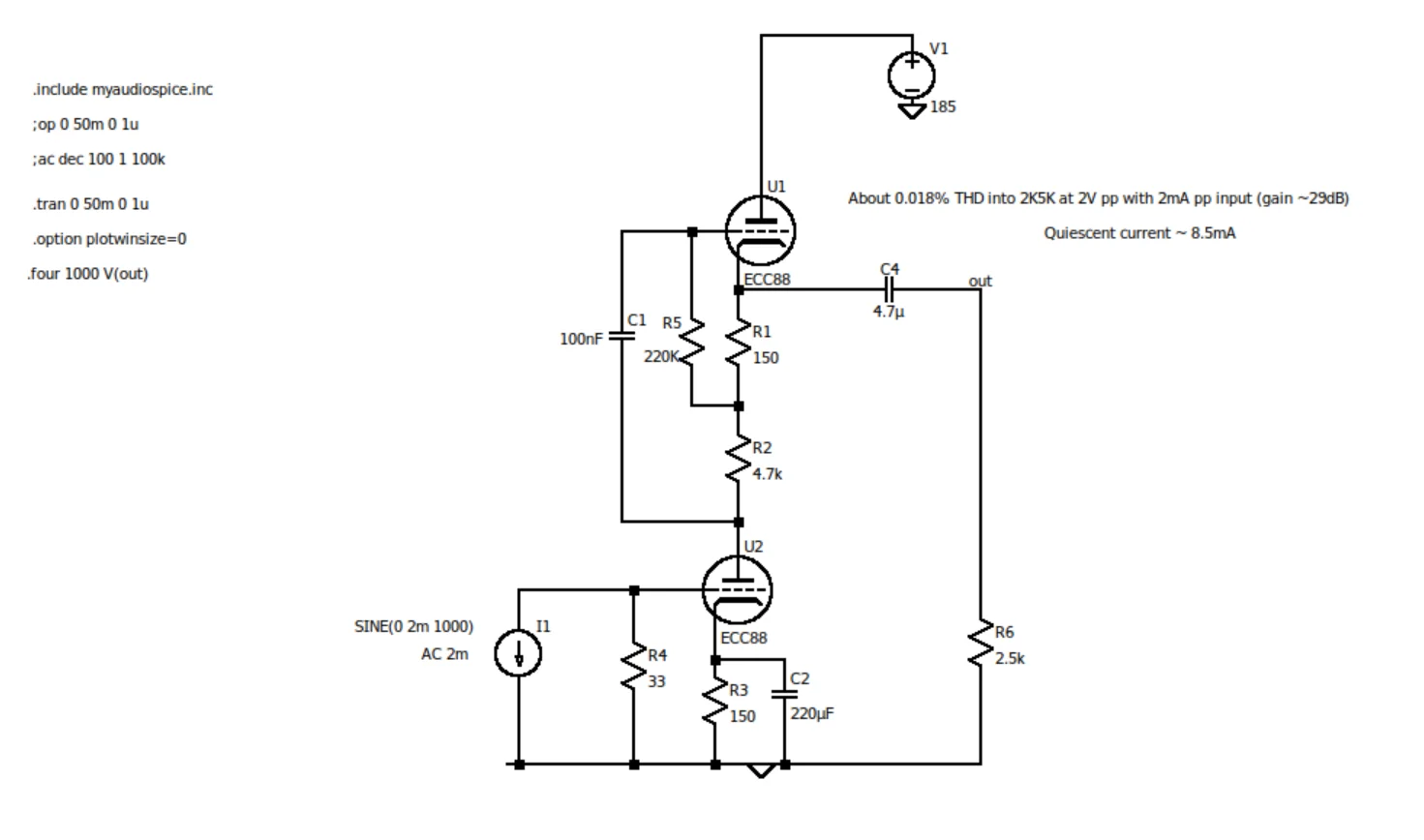
I have carried out some simulations of an ECC88 mu follower running with an HT voltage of 185V. By changing the value of the cathode resistors I ran several simulations at varying cathode currents starting around 5mA and steadily increasing. I found that beyond 8.5mA there was very little change in distortion. All these tests were with a 50K load.

Mu followers are strange in that the distortion tends to decrease as you decrease the value of the load in ohms until it reaches a minimum after which it increases again. I found the distortion remained at about 0.06% as the load varied from 50K down to 10K. As the load value was decreased further the distortion dropped rapidly down to 0.018% with a 2K5 load. I did not reduce it any further in case the stage did not have sufficient drive capability. So I suggest using a 2K7 resistor as the load in the preamp which, in parallel with your amplifiers 50K input impedance will be close to 2K5. Here is the circuit I cam up with:

ECC88muCDamp.webp


Cheers

Ian
 
I have carried out some simulations of an ECC88 mu follower running with an HT voltage of 185V. By changing the value of the cathode resistors I ran several simulations at varying cathode currents starting around 5mA and steadily increasing. I found that beyond 8.5mA there was very little change in distortion. All these tests were with a 50K load.

Mu followers are strange in that the distortion tends to decrease as you decrease the value of the load in ohms until it reaches a minimum after which it increases again. I found the distortion remained at about 0.06% as the load varied from 50K down to 10K. As the load value was decreased further the distortion dropped rapidly down to 0.018% with a 2K5 load. I did not reduce it any further in case the stage did not have sufficient drive capability. So I suggest using a 2K7 resistor as the load in the preamp which, in parallel with your amplifiers 50K input impedance will be close to 2K5. Here is the circuit I cam up with:

View attachment 11

Cheers

Ian
Thank you very much. I will build this and hope for a good result.

I am unfamiliar with the symbol to the left of R4. Is that something I can just ignore it (erase it and the line going through it)?

I suspect that the line that goes to the lower grid would be the current from the TDA1541A DAC analog out pin and the bottom line would be the analog ground from my CD player that the analog ground of the DAC chip is connected to.

One more question, I am considering using a 600mw metal foil resistor for R4 (I/V), would that be OK?
 
Thank you very much. I will build this and hope for a good result.

I am unfamiliar with the symbol to the left of R4. Is that something I can just ignore it (erase it and the line going through it)?

It is the LTspice symbol for a current source so it effectively represents your CD players current output.
I suspect that the line that goes to the lower grid would be the current from the TDA1541A DAC analog out pin and the bottom line would be the analog ground from my CD player that the analog ground of the DAC chip is connected to.

Exactly.
One more question, I am considering using a 600mw metal foil resistor for R4 (I/V), would that be OK?
That should be fine.

Cheers

Ian
 
Back
Top